A wasp nest over the front door changes the way people use a property fast. Families start avoiding the patio. Employees hesitate near a loading area. Guests notice the activity before they reach the entrance. Wasp nest removal in Florida is not a problem to ignore or solve with a quick spray when stinging insects are actively defending a nest.
Florida’s extended warm weather gives many wasp species a long season to build, expand, and reappear around homes and businesses. The right response depends on where the nest is, how active it is, and who could be exposed. A small, visible nest in an unused corner may be a straightforward service call. A large nest inside a wall, under roof eaves, or near a busy commercial entrance needs a more controlled plan.
Why Wasp Nests Become Urgent in Florida
Wasps are not automatically aggressive when they are away from the nest. The risk changes when people, pets, lawn equipment, doors, or vibrations come close to their colony. A nest near a walkway or play area can turn routine movement into repeated stings, especially when several wasps respond at once.
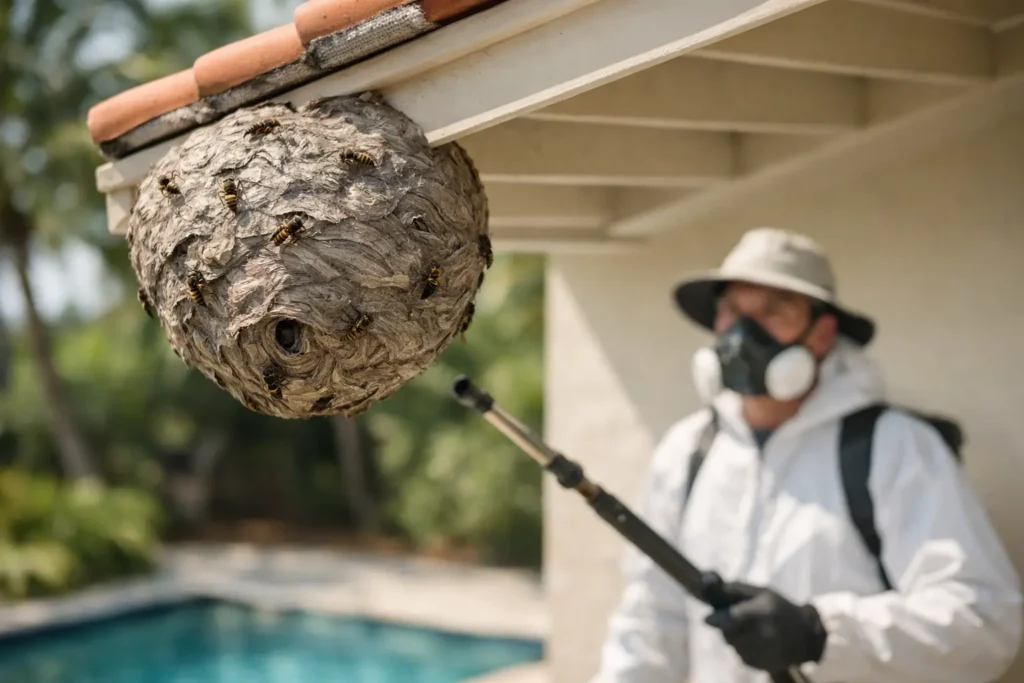
In Florida, nests often show up in places people use every day: porch ceilings, soffits, pool enclosures, sheds, fences, attic vents, outdoor light fixtures, docks, and under patio furniture. Paper wasps commonly build open, umbrella-shaped nests under protected surfaces. Yellowjackets may use concealed voids or ground locations. Hornet-like insects can create larger paper nests in trees, shrubs, or structural openings.
Correct identification matters. Not every flying insect near a structure is a wasp, and not every nest should be handled the same way. An experienced pest professional evaluates the species, nest location, activity level, access points, and the chance of hidden nests before treatment begins.
When to Call for Wasp Nest Removal in Florida
Call for professional help as soon as you see steady wasp traffic entering one point in a wall, roofline, vent, or soffit. That pattern often means the nest is concealed, and spraying the entry hole can drive insects into another part of the structure. It can also leave the colony active behind the wall.
You should also schedule service promptly when a nest is near an entrance, pool, playground, outdoor dining area, pet run, dumpster enclosure, or work zone. For restaurants, hotels, schools, healthcare facilities, and retail properties, a visible wasp issue can affect safety, guest confidence, and day-to-day operations. Waiting for the nest to grow is rarely the better trade-off.
Immediate attention is especially warranted if someone on the property has a known insect-sting allergy. A single sting can be serious for a sensitive person, while multiple stings can be dangerous for anyone. If a person develops trouble breathing, swelling of the face or throat, dizziness, widespread hives, or other severe symptoms after a sting, seek emergency medical care right away.
Why DIY Nest Removal Can Backfire
It is tempting to buy an aerosol product and deal with the nest after dark. The problem is that dark does not make a nest harmless. Wasps can still react quickly when disturbed, and a missed nest, poor spray angle, or unstable ladder can create a much bigger safety issue than the nest itself.
DIY treatment is particularly risky when the nest is elevated, concealed, unusually large, or located near a door or window. Knocking down a visible nest without treating the active population may leave wasps circling the area or attempting to rebuild nearby. Sealing an active wall opening can be another mistake, because insects may find their way indoors instead.
Avoid pouring chemicals into ground nests, burning nests, hitting them with tools, or using a hose to wash them down. These methods do not provide dependable control and can provoke a defensive swarm. They can also expose children, pets, customers, and employees to avoidable pesticide contact or stings.
What Professional Wasp Service Looks Like
Safe, effective removal starts with an inspection. A technician confirms the likely nesting site and determines whether the activity is from an exposed paper nest, a concealed void, a ground nest, or another protected location. This step helps prevent treating the wrong area and reveals conditions that may support future nesting.
Treatment is selected for the specific situation. For an accessible nest, the technician may treat the nest directly and remove it once activity has stopped. For nests in wall voids, rooflines, or other enclosed areas, the approach is more precise. The goal is to control the colony while limiting the chance that wasps relocate into occupied spaces.
After the active nest is addressed, the technician can point out conditions that are making the property attractive. This may include open gaps around utility lines, damaged screens, unsealed soffit openings, cluttered storage areas, or food and trash sources that keep stinging insects nearby. Removal handles the immediate threat. Exclusion and sanitation help reduce the odds of another nest in the same spot.
At Florida Bug Control, service is built around the urgency of the issue. A wasp nest near a family entrance or a customer-facing business area should not require a long wait or an uncertain outcome. The focus is safe treatment, clear communication, and return service if the problem persists.
Steps to Take Before Help Arrives
Keep people and pets away from the nest area. If the nest is near a doorway, use another entrance when possible and let household members, tenants, staff, or visitors know why the area is restricted. Do not stand close to watch wasp activity or try to identify the nest by tapping, shaking, or moving the surface around it.
If you can do so from a safe distance, note where you see wasps entering and leaving. A photo taken from well away from the nest can be useful, but it is not worth getting stung for. For property managers and business owners, document the exact location and any recent sting incidents so the service team can prioritize the right area.
Keep outdoor food covered and empty trash regularly, particularly around patios, break areas, and dumpster zones. This will not eliminate an established nest, but it can reduce the number of foraging wasps around people while you wait for treatment.
Preventing the Next Nest
There is no permanent guarantee that a wasp will never investigate a Florida property again. Warm weather, sheltered structures, and abundant food sources make many homes and facilities attractive. Prevention is about making preferred nesting sites harder to access and catching early activity before a colony becomes established.
Inspect eaves, porch ceilings, shed overhangs, fence lines, and pool structures periodically during the warmer months. Early nests are often small and easier to address before the colony expands. Repair torn window screens, close gaps around vents and pipes, and keep exterior doors properly sealed. On commercial properties, include wasp activity in routine exterior inspections around receiving areas, outdoor seating, signage, landscaping, and waste handling zones.
It also helps to keep landscaping trimmed away from buildings where practical. Branches and dense shrubs near rooflines can give wasps sheltered routes to structural gaps. The right amount of trimming depends on the property and plantings, but maintaining clear visibility around key entry points makes early detection easier.
A wasp nest does not have to become the reason your family avoids the yard or your customers avoid the entrance. Keep your distance, skip the risky shortcuts, and get a trained professional involved before a small nest becomes a larger safety problem.